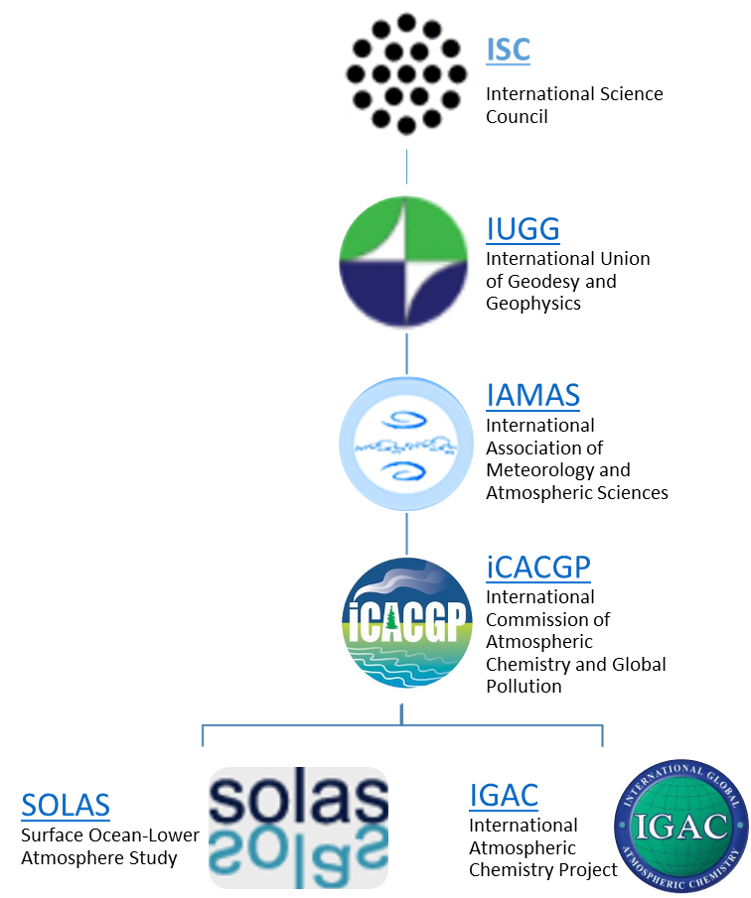
The international Commission on Atmospheric Chemistry and Global Pollution (iCACGP) is one of 10 commissions under the International Association of Meteorology and Atmospheric Sciences (IAMAS), which is in turn part of the International Union of Geodesy and Geophysics (IUGG). Established in 1957 to foster a deeper understanding of atmospheric chemistry and its global implications, iCACGP has been instrumental in promoting and coordinating international scientific research on atmospheric chemistry and its interactions with climate, ecosystems, and human societies.
iCACGP sponsors two significant projects that align with its mission, which are the International Global Atmospheric Chemistry (IGAC) project and the Surface Ocean-Lower Atmosphere Study (SOLAS).
International Global Atmospheric Chemistry (IGAC) Project
The IGAC project, initiated in 1990, is a core project of iCACGP. It focuses on advancing the understanding of atmospheric chemistry and its impact on climate, air quality, and ecosystems. IGAC operates through a series of working groups and activities that address a wide range of topics, from biogeochemical cycles and aerosols to human impacts on atmospheric chemistry. Over the years, IGAC has played a crucial role in shaping the global research agenda in atmospheric chemistry, fostering collaborations, and disseminating knowledge through its workshops, conferences, and publications.
Surface Ocean-Lower Atmosphere Study (SOLAS)
SOLAS, established in 2000, is an interdisciplinary research initiative co-sponsored by iCACGP and the Scientific Committee on Oceanic Research (SCOR). This project aims to understand the key biogeochemical-physical interactions and feedbacks between the ocean and atmosphere. By examining how these interactions affect the Earth’s climate, air quality, and marine ecosystems, SOLAS contributes significantly to our understanding of the Earth system. The project’s research themes include gas exchange, organic matter cycling, atmospheric inputs to the ocean, and interactions between ocean biogeochemistry and climate..
Both IGAC and SOLAS have been pivotal in advancing the scientific community’s understanding of atmospheric chemistry and its interactions with various Earth system components. Their contributions have been crucial in informing policy decisions related to climate change, air quality, and environmental sustainability.
The work of iCACGP, through projects like IGAC and SOLAS, underscores the importance of international collaboration in addressing complex global environmental challenges. By bringing together scientists from diverse disciplines and regions, iCACGP fosters a holistic understanding of atmospheric chemistry and its role in the Earth system, paving the way for informed actions to protect our planet and its inhabitants.
Interactions with other international organizations
The iCACGP also interacts with other international organizations that include atmospheric chemistry or global air pollution in their activities. Namely, with these groups:
iLEAPS (Integrated Land Ecosystem-Atmosphere Processes Study) is a global research project of Future Earth that investigates the complex interactions at the land-atmosphere interface. Its focus is on how physical, chemical, and biological processes govern the exchange of energy and matter. For iCACGP, the work of iLEAPS is critical for understanding the sources, sinks, and transport of atmospheric constituents, such as trace gases and aerosols, that are controlled by terrestrial ecosystems and their response to climate change. This collaboration provides a vital link between the atmospheric chemistry community and the land-surface and ecosystem science communities.
APARC (Atmospheric Processes And their Role in Climate) is a core project of the World Climate Research Programme. It coordinates international efforts to bring knowledge of the atmosphere to bear on issues regarding climate variability and prediction. APARC themes and activities address areas of societal concern such as atmospheric dynamics and predictability, chemistry and climate, and long-term records for climate understanding. APARC’s focus on ‘chemistry and climate’ directly aligns with iCACGP’s mission to understand the chemical processes influencing our climate. Furthermore, APARC’s work on atmospheric dynamics provides the essential physical context for studying the transport and transformation of global air pollutants, which is a primary interest of the iCACGP community.
The Global Atmosphere Watch (GAW) Programme, operated by the World Meteorological Organization (WMO), is a global long-term monitoring network for atmospheric composition. GAW focuses on providing high-quality, comprehensive data on greenhouse gases, ozone, aerosols, and other reactive gases. The GAW network is a cornerstone for the research promoted by iCACGP, offering the foundational, globally-coordinated observations needed to track changes in atmospheric composition, validate models, and understand the interactions between the atmosphere, oceans, and biosphere.
COSPAR (Committee on Space Research) is a scientific committee of the International Science Council that promotes and coordinates international scientific research in space. Its objectives include fostering the exchange of results and providing a forum for discussing scientific problems that can be addressed using space-based technology. For iCACGP, COSPAR is a vital partner because space-borne instruments provide a unique global perspective on atmospheric chemistry. Satellite observations are indispensable for monitoring air pollution, tracking the long-range transport of pollutants, and observing the distribution of key atmospheric constituents, all of which are central to iCACGP’s research focus.