The iCACGP-IGAC 2026 Joint Conference, with the theme Atmospheric Chemistry within the Earth System: Understanding Changes and Impacts, was held 6-11 September 2026 in Heraklion, Crete, Greece. The conference was organized jointly by the international Commission on Atmospheric Chemistry and Global Pollution (iCACGP) and the International Global Atmospheric Chemistry (IGAC) Project to provide a venue for communicating and promoting core research on atmospheric chemistry and composition, their contribution to air pollution and climate, and their effects on humans and the biogeosphere. Over 700 scientists attended the conference from over 30 countries. Approximately half of the attendees were early career researchers, defined as a student or researcher within three years of graduation.
The scientific program addressed a variety of topics including: fundamental atmospheric chemistry processes, emissions and air pollution, interactions of atmospheric chemistry with the oceans, land, and ice in a changing atmosphere, climate-air quality interactions, and innovative approaches to observations and modeling. Each of these sessions showcased results from two invited speakers, over 10 oral presentations, and numerous posters. A highlight of the conference were presentations by four keynote speakers who spoke about frontier science topics in relation to laboratory studies (by Dr. Vicki Grassian), new satellite measurements of a variety of trace gases (by Dr. Cathy Clerbaux), chemistry transport modeling to understand volatile organic compounds in forested regions (by Dr. Allison Steiner), and measurements and analysis of atmospheric organic aerosols that comprise a major portion of atmospheric aerosols (by Dr. Spyros Pandis). There was a panel discussion on Emerging Opportunities and Challenges for Atmospheric Chemistry in a Changing Environment, for an interactive discussion on the future of atmospheric chemistry. The conference supported several side meetings to provide a means for scientists to coordinate international activities.
The conference facilitated several activities for early career researchers (ECRs). IGAC supported an Early Career Short Course before the conference (see accompanying article). In addition, there was an early career researcher program during the conference with activities that foster networking among ECRs and between ECRs and senior scientists, including a lunch with senior scientists, a grant writing discussion, and a dialogue about challenges facing ECRs and how senior scientists can help. Six ECRs received presentation awards: one for best oral presentation among all the oral sessions, and five for best poster for each session topic. The winners were: Sathish Kumar Vaithiyanadhan (poster), Maria Paula Velásquez García (poster), Helena King (poster), Beata Opacka (poster), Nattamon Maneenoi (poster), and Irene Monreal-Campos (oral presentation). Further, the Paul Crutzen Early Career Award, given to an outstanding ECR within seven years of their Ph.D. graduation, was awarded.
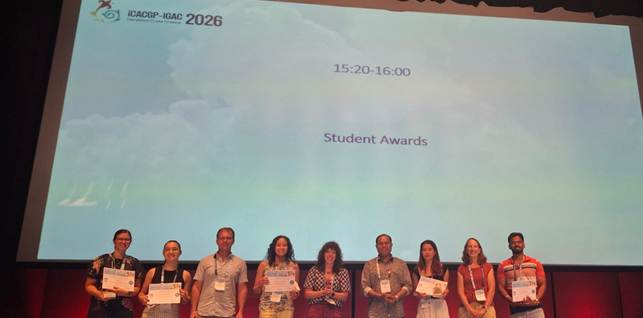
Early Career Researcher Presentation Award Winners. From left: Helena King (poster awardee), Irene Monreal-Campos (oral presentation awardee), Owen Cooper (IGAC SSC co-chair), Maria Paula Velásquez García (poster awardee), Langley DeWitt (IGAC Executive Director), Abdus Salam (IGAC SSC co-chair), Nattamon (Jeep) Maneenoi (poster awardee), Mary Barth (iCACGP President), and Sathish Kumar Vaithiyanadhan (poster awardee). Not pictured: Beata Opacka (poster awardee).